

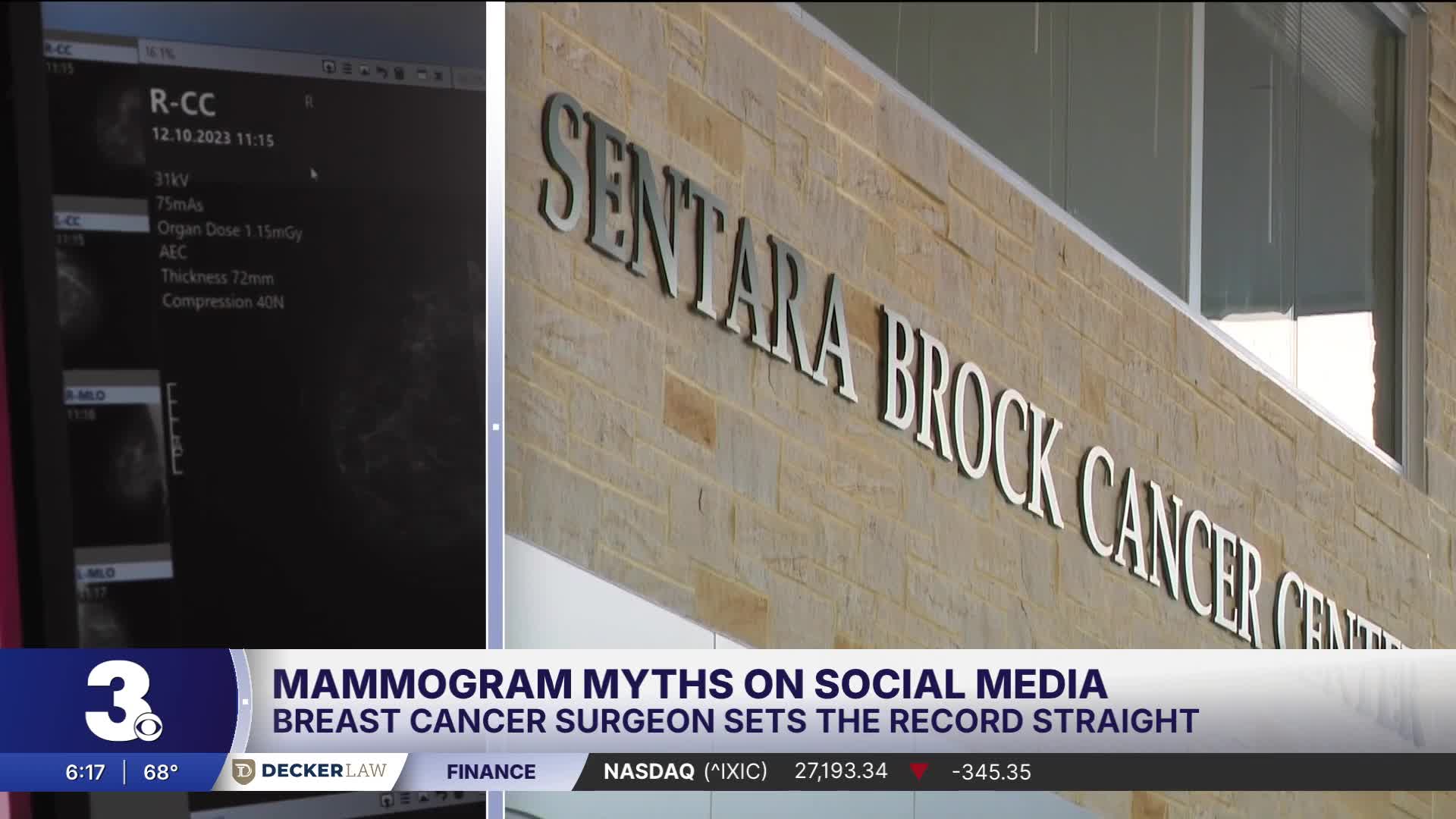


VIRGINIA BEACH, Va. — Misinformation about mammograms is spreading across social media, and a Sentara Health oncology breast surgeon wants to set the record straight.
A Facebook post encouraging women to get mammograms sparked a flood of online media comments — many filled with misinformation. I collected some comments, removed the names, and shared them with Dr. Jennifer Reed, an oncology breast surgeon with Sentara Health. Dr. Reed said she wants to correct the record on breast cancer screening.
One comment claimed: "They don't mention that one out of eight women will get cancer from a breast mammogram."
"So that is a big myth. One in eight women get breast cancer in their lifetime, period. These are people either who had mammograms or didn't have mammograms," Dr. Reed said.
Dr. Reed said the radiation from a mammogram is not a cause of breast cancer.
"When people say this, I'm like they're not getting the cancer from a mammogram. A mammogram has such low radiation, you're not going to get cancer from that," Dr. Reed said. "You're also not getting it from your deodorant."
Another comment read: "I'm under 50, so I don't need to worry about breast cancer yet."
"Unfortunately, our younger women less than 50, that is the one age group where the incidence of breast cancer is going slightly higher each year. I think it's about 1.4% each year it's increasing. We're seeing the same thing in colon cancer; the ages are getting younger. Have I seen 20-year-olds that have breast cancer? Yeah, I have," Dr. Reed said.
"Those are the ones that break your heart when you see them because you just want to help them so much and hope to see them live a long life. I've had 26-year-olds that got breast cancer. How did they find it? Normally in the shower washing themselves."
Dr. Reed recommends that women start self-breast self-exams in their twenties.
A third comment claimed: "A self-examination is enough to check for breast cancer."
"So, self-examination is good..." Dr. Reed said.
"But it's not enough. Unfortunately, when you normally catch a mass on self-exam, it's significantly larger than if you had caught it when it was on mammogram. You can generally pick something up that's about one centimeter or less on mammogram, but when you talk about doing a self-exam, normally it's about two centimeters."
I noted that a mass has to be large enough to feel before it can be detected through self-exam. Dr. Reed said that is the problem — particularly for some women.
"Unfortunately for the girls with large breasts it's way back there inside that breast tissue, you may never feel it," Reed said.
A fourth comment suggested: "People without a family history of breast cancer don't need a mammogram."
"80% of patients who have or develop breast cancer don't have a family history. So, there are about 15 to 20% of breast cancers that we call hereditary or familial, everyone in the family seems to get it, but we haven’t quite found the gene yet," Dr. Reed said. "Or maybe they're just predisposed or they lived in an area that there was a problem.
"But you really have to sit there and think about this. 80% of people, that means, you know, it was like the majority of the people who walk around and say, ah, I don't have a family history. I need a mammogram."
Another person mentioned thermology as an option over mammograms.
"It's a modality that some people like to use, but it is not tried and true. We know mammograms are tried and true. We actually have the long-term data on mammograms that it improves your survival, improves your outcomes, whereas with thermography, yeah, sometimes they call you, say you have breast cancer and you really don't. Sometimes they say you don't have breast cancer and you actually do."
A sixth comment said: "My breasts are too big or too small for me mammogram machine."
In response Dr. Reed said, "there is no such thing as too big or too small on a mammogram machine."
"Sometimes if you do have very large breasts, they do have to take two images across as opposed to just one image or two images up and down. With small breasts, they will still pull [them] in there."
Dr. Reed's message to women is direct.
"Don't skip the mammogram, please, no. Don't skip the mammogram," Dr. Reed said.
Dr. Reed's statements are also supported by the American Cancer Society.
This story was reported on-air by a journalist and has been converted to this platform with the assistance of AI. Our editorial team verifies all reporting on all platforms for fairness and accuracy.
Click here to see how we use AI at WTKR News 3.
