

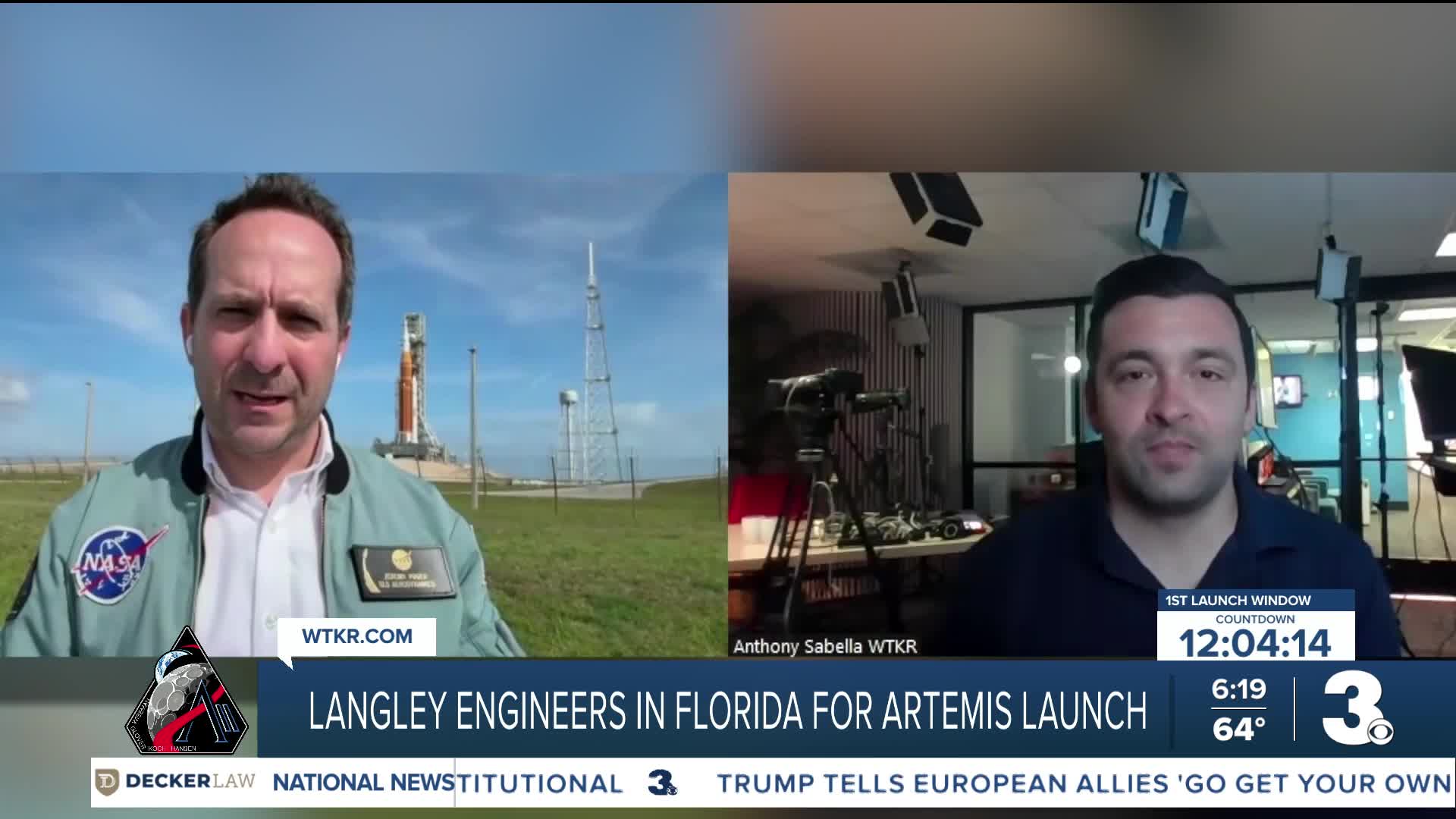


CAPE CANAVERAL, Fla. — More than a dozen engineers from the Space Launch System project at NASA Langley Research Center are in Florida this week for the scheduled Artemis II mission launch.
The launch window opens Wednesday at 6:24 p.m., with launch opportunities for the next six days.
NASA's Artemis mission intends to get humans back to the moon's surface for the first time in more than 50 years, followed by the establishment of a permanent Moon base. First, Artemis II will take a crew of four astronauts around the moon and back.
The Orion space capsule currently sits atop a rocket at the Kennedy Space Center launchpad.
“We’re gonna be looking at data and we’re gonna be focused," Jeremy Pinier, the lead for the Space Launch System (SLS) project, told News 3 from Florida on Tuesday.
Pinier says he and another dozen Hampton-based SLS engineers made the trip from Langley to see the launch in person and make sure their portion of the mission goes well.
News 3 last spoke with Pinier in 2022 before the launch of the uncrewed Artemis I mission. He says his team has since made some changes to the Artemis rocket with the help of data collected from the first mission.
“We bolted four 90-inch-long fins to the rocket in order to steady the flow as it’s flying really fast through the atmosphere," he said. "Hopefully that reduces all the shaking from the first flight and keeps our astronauts safe.”
Astronauts Reid Wiseman, Victor Glover, Christina Koch and Jeremy Hansen will be inside the space capsule for the nine-day mission. Pinier says another change for Artemis II is the ability for the capsule to detach from the rocket in the event of an emergency.
"We have a launch abort system that can carry the crew away from the rocket as fast as possible," he told News 3.
But, of course, the hope is that everything goes according to plan and the astronauts return home safely after journeying farther into space than any other human. Then, Pinier and the other Langley engineers working on Artemis will get back to working toward another lunar landing, which will take the first woman and first person of color to the moon's surface.
Nearly 60 years ago, Neil Armstrong — the first man to make the leap — trained at NASA Langley ahead of the Apollo mission.
”It’s in our blood in Hampton, Virginia to go to the moon," said Pinier. ”It’s something Hampton Roads residents should be proud of.”
If Artemis II doesn't launch in the next week, the next window won't come until the end of April. According to NASA, Artemis III will launch next year, with a goal to get humans back to the moon aboard Artemis IV as early as 2028.
