

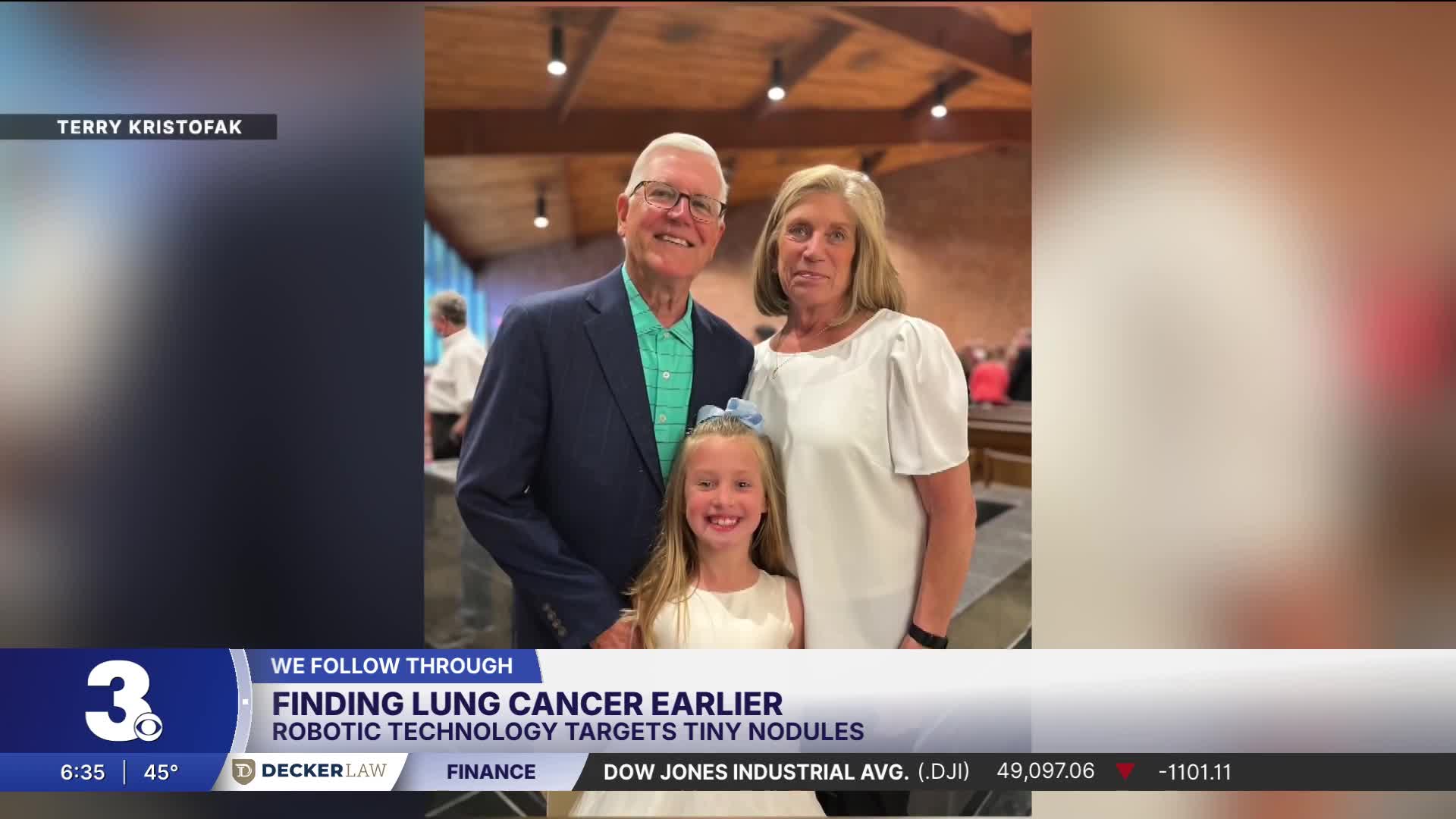


NORFOLK, Va. — It's important for Terry Kristofak to stay active.
"I plant my flowers. I trim my bushes. I crochet," Kristofak said.
To do the things she loves, the Virginia Beach resident needs to be able to breathe. It's part of the reason the mom and grandmother quit smoking after 45 years.
"There was always the concern: the family history, my mother passing away with lung cancer and my smoking history," Kristofak said.
She was getting routine non-invasive CT scans at Sentara Health when a scan revealed a problem.
"Unfortunately, the [scan] last September had a nodule in it, a small nodule," Kristofak said.
"And at 6 months, that lesion had doubled in size, doubled."
She saw Dr. Simanta Dutta, a pulmonary and critical care physician, who performed a robotic bronchoscopy. It's when doctors use a robotic-guided tube to look inside the lungs and take tissue samples. It allows doctors to access hard-to-reach areas and be more precise with their diagnoses.
I met Dutta in February 2026 when he had his first patient with the technology. Now, more than 140 procedures later, he says the impact has been significant.
"We have been able to diagnose a lot of lung cancers in very early stages, which has made a tremendous impact," Dutta said.
"On our first 100 patients, 73% of the diagnosed lung cancers are in stage one and stage two," Dutta said.
He says every week's delay of testing raises the risk of upstaging by 4%, whereas the earlier a cancer is treated, the better the survival rates.
"As we are getting more proficient with using this device we are targeting smaller and smaller lesions," Dutta said.
"The smallest lesion we got was a 7-millimeter nodule which is incredibly small. It's like the size of a Kernel of corn," Dutta said.
This technology was notably used by Pope Leo XIV in October when he underwent a robotic bronchoscopy before a surgery to evaluate a nodule in his lung. He was diagnosed with lung cancer. It was later reported by the Vatican, after his surgery, he needed no further treatment.
Dutta says the Pope and Kristofak are examples of the success.
"It's so easy. It's so easy. There's nothing to fear. You're in, you're out, you're done, and you get a diagnosis on the smallest of nodules," Kristofak said. "It was my lifesaver. "
According to the American Cancer Society, lung cancer is the second most common in men and women. But you can act for your health today.
You're recommended to get a low-dose CT scan if you:
- Are between 50 and 80 years old
- Have smoked one pack a day for 20 years or two packs a day for 10 years
- Are actively smoking or have quit in the past 15 years
In an episode of the Healthy Dude Podcast, Host and News 3 Anchor Kurt Williams is joined by Dr. Raffaele Marchigiani, clinical chief of thoracic surgery at Sentara Leigh Hospital, to discuss the ins and outs of lung cancer, what you should expect if you are part of the 10-20% of non-smokers diagnosed, and more.
This story was reported on-air by a journalist and has been converted to this platform with the assistance of AI. Our editorial team verifies all reporting on all platforms for fairness and accuracy.
Click here to see how we use AI at WTKR News 3.
